

Ram Dongre studied Painting at the Indira Kala Sangit Vishwavidyalaya, Khairagarh, where he also completed his MFA. He came to painting through his father, a maker of idols of gods and goddesses for the festival cycle, alongside whom he worked from childhood. The biographical fact matters because his practice carries forward, in another form, exactly what idol-making is: the labour of creating an image meant to be made, venerated, and dissolved. Ram’s medium today is oil on canvas. His method, increasingly, is erasure.
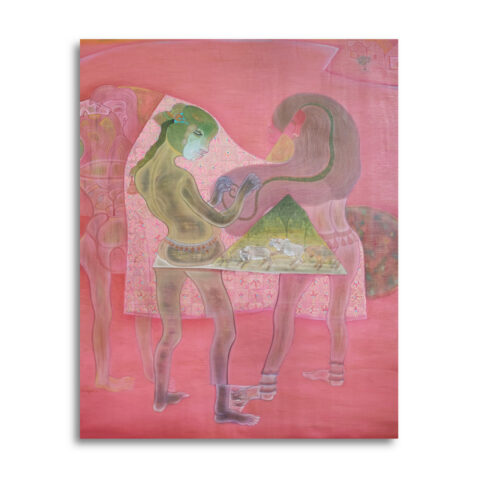
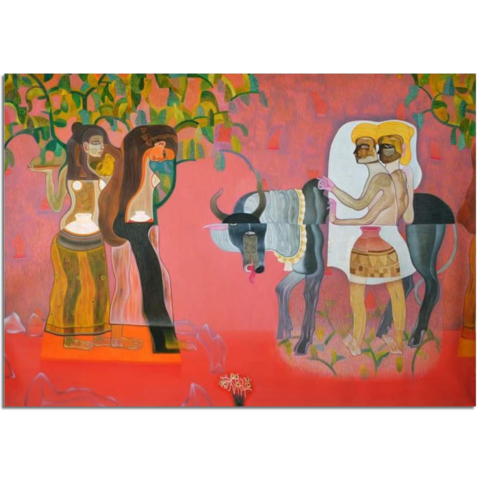
His practice has been a sustained, restless evolution within a single medium, figurative imagery in oil, moving through phases dominated at different times by colour and by line, while the figure itself remains the constant return. He paints visages from the Puranic tradition, gods and goddesses inflected by the Dokra figurines and the tribal terracotta cultures of Madhya Pradesh, set against compositions thick with the flora and fauna of Indian fables and miniature painting. The mode is magical realism: the imagined sat inside the real, neither rebuked nor reconciled. The Indian lineage he claims is the Progressives, S.H. Raza’s Bindu and V.S. Gaitonde’s sublime, and the long iconographic conversation that runs from Bhimbetka and Ajanta through to the present.
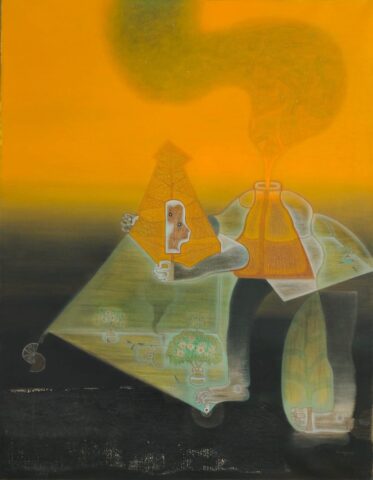
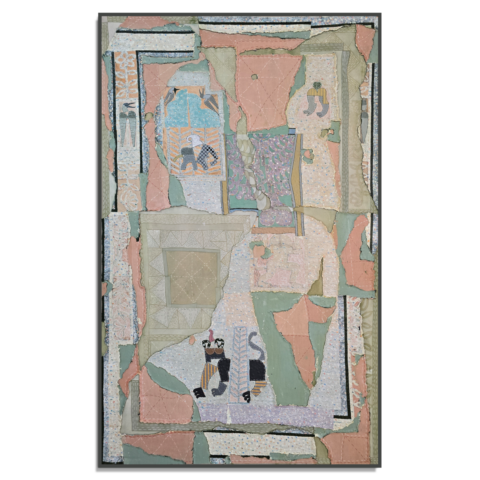
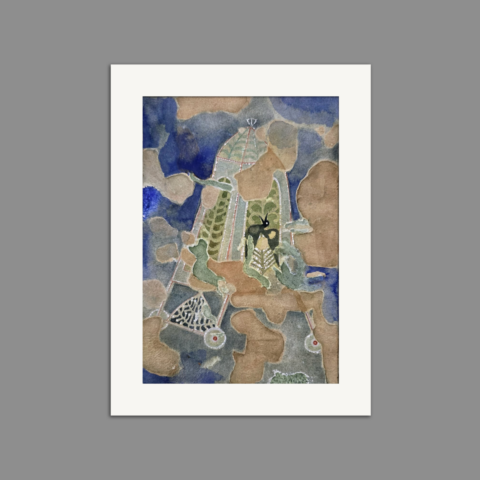
The current practice turns on a method that is unusually direct. Ram erases his own paintings, layer by layer, to reveal what he calls their essence: the way a childhood memory persists as fragments rather than as scenes. What remains is colour in arrest, the preserved residue of fuller images that once were. The series Sesh Avshesh (Hindi for residues, remains) makes the argument explicit, a body of work that reads as a contemporary commentary on the deterioration of the great mural traditions, the cracks and crevices of Ajanta and Bhimbetka returned to the painter’s surface. Roland Barthes’s The Pleasure of the Text sits usefully behind the work, the proposition that every sign carries multiple meanings revealed only on repeated reading, applied here to the visual.
For UK and European curators, the conversation Ram joins is already familiar. The erasure method places him in dialogue with Robert Rauschenberg’s Erased de Kooning Drawing, with William Kentridge’s drawn-and-undrawn animations, and with Anselm Kiefer’s burnt and distressed surfaces. The miniature-meets-magical-realism register places him alongside Imran Qureshi, Khadim Ali, and Shahzia Sikander, the contemporary miniature lineage UK and US institutions have been programming around for the past decade. He has also recently moved into terracotta sculpture, drawing on the votive figurine traditions of the Bhil, Bhilala, Barela, and Manka communities of Madhya Pradesh, and extending the painterly inquiry into three dimensions.
The international attention has arrived quickly. In 2025, Forbes named Ram one of seven artists to watch at the London Art Fair, and he is currently a selected artist on the Embassy of Germany’s Art in Residence programme in New Delhi. The work has found early homes in serious private and institutional collections, including Kumar Mangalam Birla, Boston Consulting Group, Mindscreen, SAS Hotels Madurai, and Ambattur Hotels, and continues to be acquired at speed. For an exhibition gathered around craft as contemporary language, Ram brings its most contemplative pulse: a painter who treats erasure not as loss but as the slow uncovering of what was always essential. His work continues the cycle his father taught him, the cycle of making and unmaking that Indian craft has always known.
Recognition: Forbes, “Seven Artists to Watch at London Art Fair,” 2025. International presentations: London Art Fair, London, 2025. Selected residency: Art in Residence, Embassy of Germany, New Delhi (current). Selected collections: Kumar Mangalam Birla; Boston Consulting Group; Mindscreen; SAS Hotels, Madurai; Ambattur Hotels.
Ram Dongre studied Painting at the Indira Kala Sangit Vishwavidyalaya, Khairagarh, where he also completed his MFA. He came to painting through his father, a maker of idols of gods and goddesses for the festival cycle, alongside whom he worked from childhood. The biographical fact matters because his practice carries forward, in another form, exactly what idol-making is: the labour of creating an image meant to be made, venerated, and dissolved. Ram’s medium today is oil on canvas. His method, increasingly, is erasure.
His practice has been a sustained, restless evolution within a single medium, figurative imagery in oil, moving through phases dominated at different times by colour and by line, while the figure itself remains the constant return. He paints visages from the Puranic tradition, gods and goddesses inflected by the Dokra figurines and the tribal terracotta cultures of Madhya Pradesh, set against compositions thick with the flora and fauna of Indian fables and miniature painting. The mode is magical realism: the imagined sat inside the real, neither rebuked nor reconciled. The Indian lineage he claims is the Progressives, S.H. Raza’s Bindu and V.S. Gaitonde’s sublime, and the long iconographic conversation that runs from Bhimbetka and Ajanta through to the present.
The current practice turns on a method that is unusually direct. Ram erases his own paintings, layer by layer, to reveal what he calls their essence: the way a childhood memory persists as fragments rather than as scenes. What remains is colour in arrest, the preserved residue of fuller images that once were. The series Sesh Avshesh (Hindi for residues, remains) makes the argument explicit, a body of work that reads as a contemporary commentary on the deterioration of the great mural traditions, the cracks and crevices of Ajanta and Bhimbetka returned to the painter’s surface. Roland Barthes’s The Pleasure of the Text sits usefully behind the work, the proposition that every sign carries multiple meanings revealed only on repeated reading, applied here to the visual.
For UK and European curators, the conversation Ram joins is already familiar. The erasure method places him in dialogue with Robert Rauschenberg’s Erased de Kooning Drawing, with William Kentridge’s drawn-and-undrawn animations, and with Anselm Kiefer’s burnt and distressed surfaces. The miniature-meets-magical-realism register places him alongside Imran Qureshi, Khadim Ali, and Shahzia Sikander, the contemporary miniature lineage UK and US institutions have been programming around for the past decade. He has also recently moved into terracotta sculpture, drawing on the votive figurine traditions of the Bhil, Bhilala, Barela, and Manka communities of Madhya Pradesh, and extending the painterly inquiry into three dimensions.
The international attention has arrived quickly. In 2025, Forbes named Ram one of seven artists to watch at the London Art Fair, and he is currently a selected artist on the Embassy of Germany’s Art in Residence programme in New Delhi. The work has found early homes in serious private and institutional collections, including Kumar Mangalam Birla, Boston Consulting Group, Mindscreen, SAS Hotels Madurai, and Ambattur Hotels, and continues to be acquired at speed. For an exhibition gathered around craft as contemporary language, Ram brings its most contemplative pulse: a painter who treats erasure not as loss but as the slow uncovering of what was always essential. His work continues the cycle his father taught him, the cycle of making and unmaking that Indian craft has always known.
Recognition: Forbes, “Seven Artists to Watch at London Art Fair,” 2025. International presentations: London Art Fair, London, 2025. Selected residency: Art in Residence, Embassy of Germany, New Delhi (current). Selected collections: Kumar Mangalam Birla; Boston Consulting Group; Mindscreen; SAS Hotels, Madurai; Ambattur Hotels.
Art Incept, 227 South Point Mall, Golf Course Rd, DLF Phase 5, Gurugram, Haryana 122002
S-137 Panchsheel Park, New Delhi 110017
Copyright © 2025 Art Incept