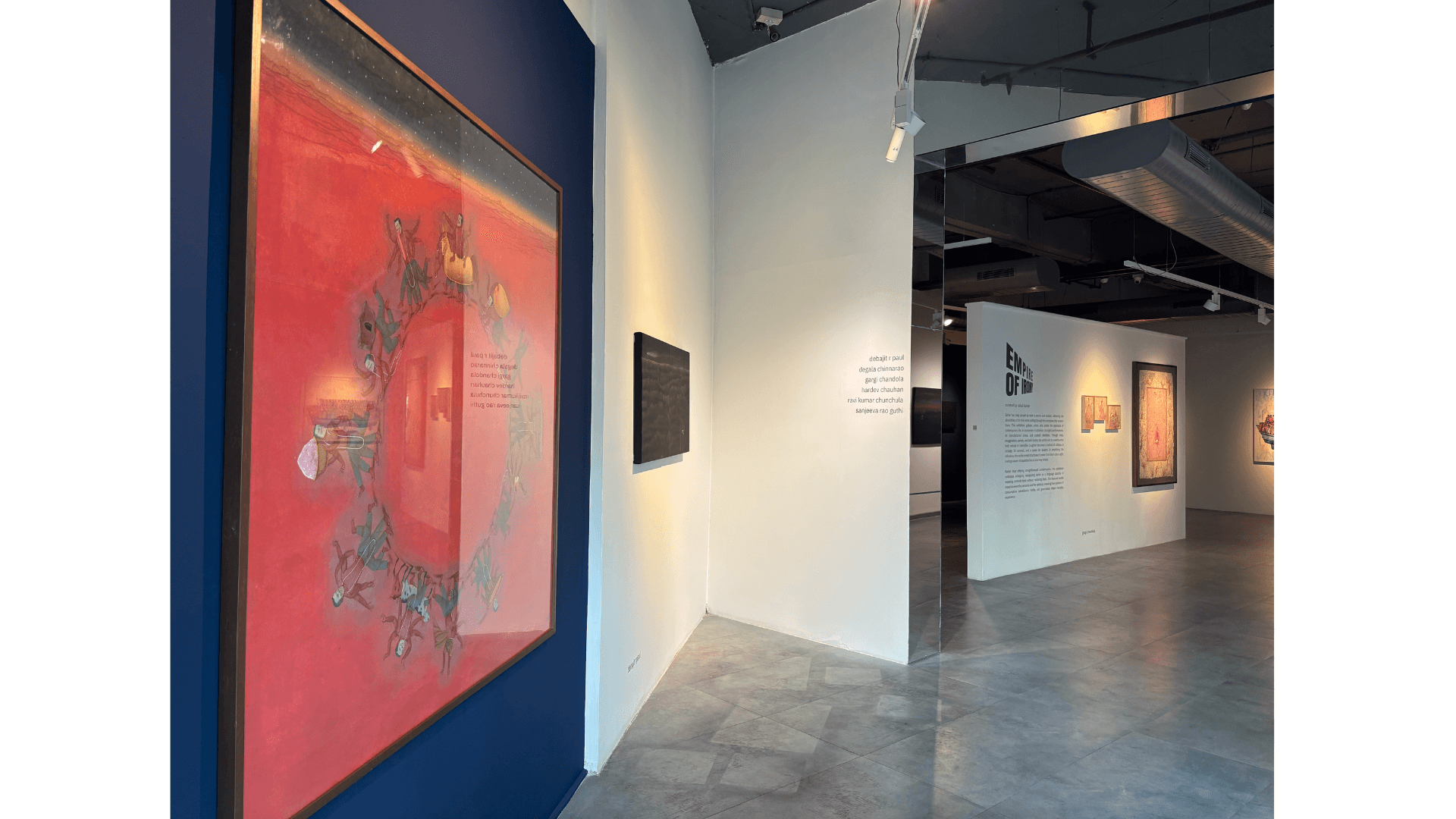
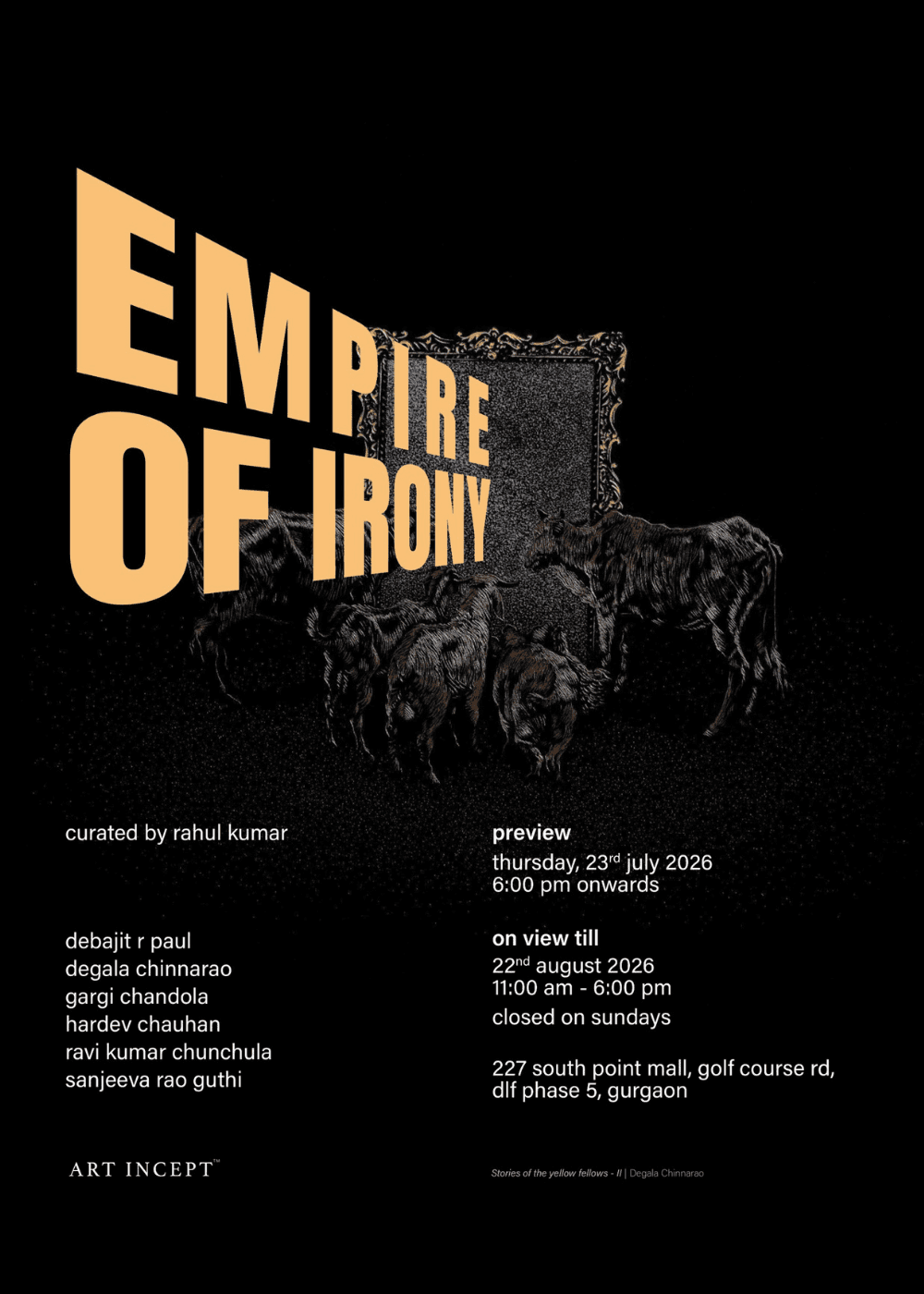
Empire of Irony
Curated by Rahul Kumar
227, Second Floor, South Point Mall, Golf Course Rd., Sec 53, Gurgaon
Featuring DEBAJIT R PAUL, HARDEV CHAUHAN, SANJEEVA RAO GUTHI, GARGI CHANDOLA and DEGALA CHINNARAO
Jul 23 – Aug 22, 2026
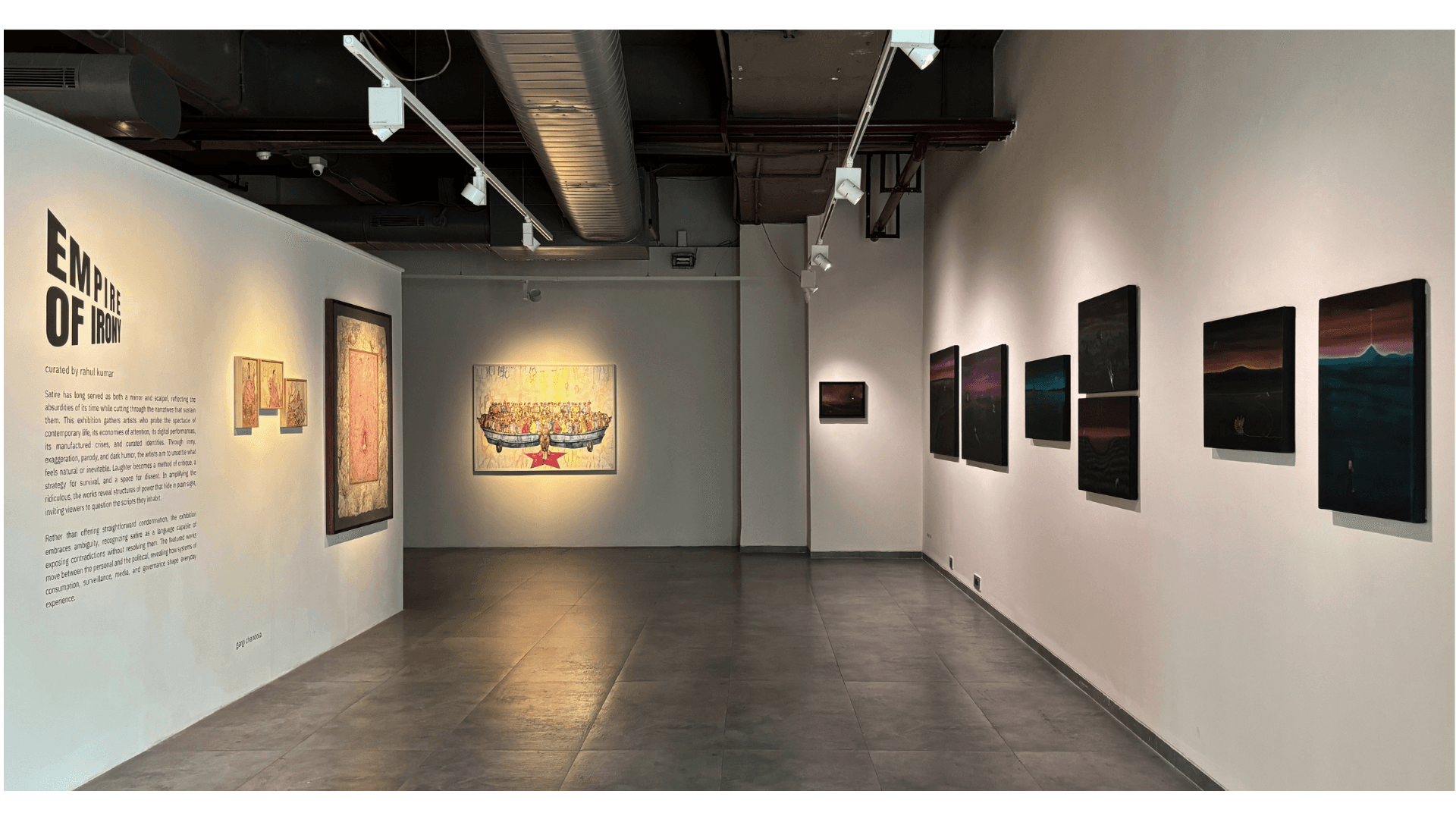
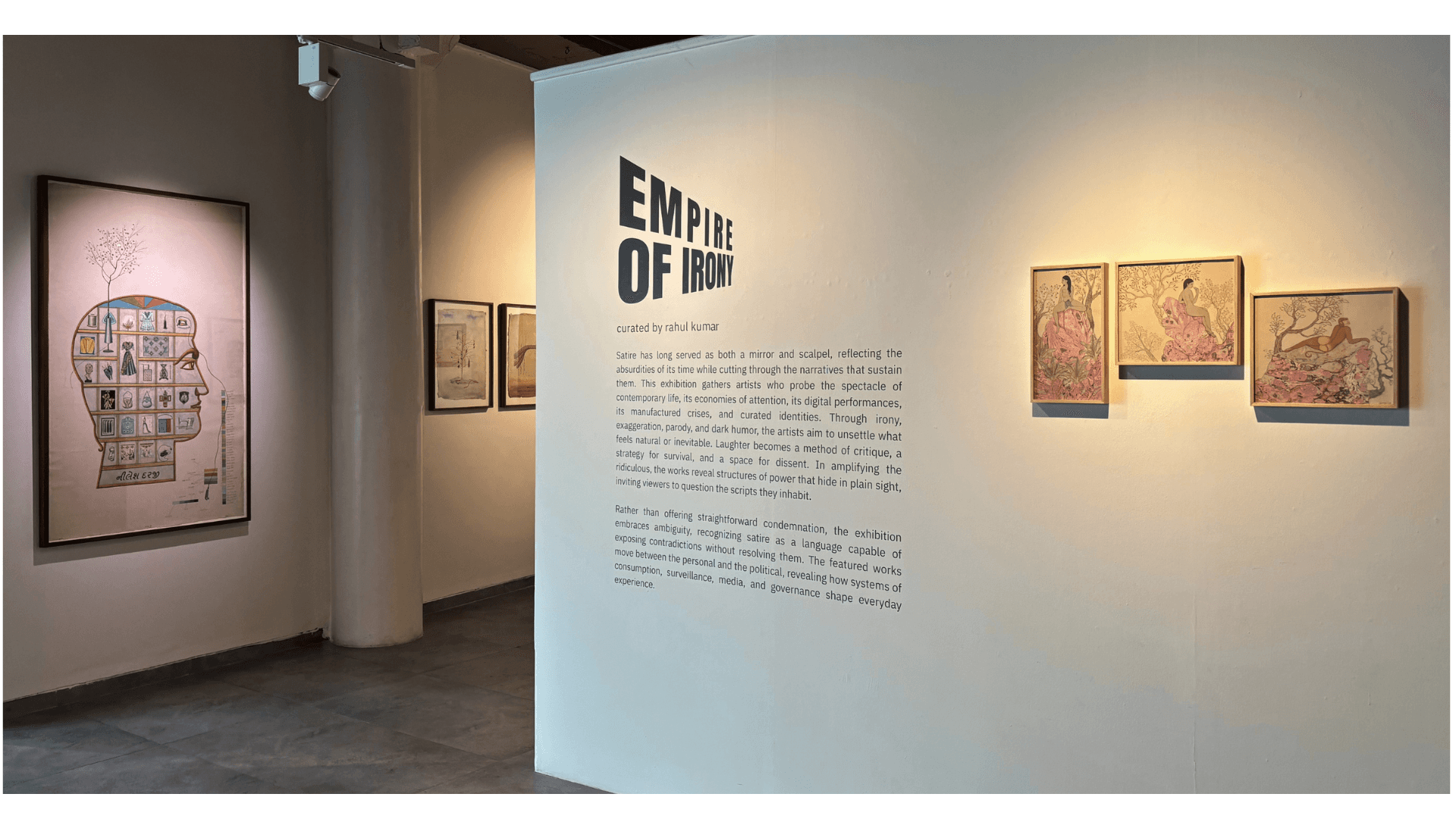
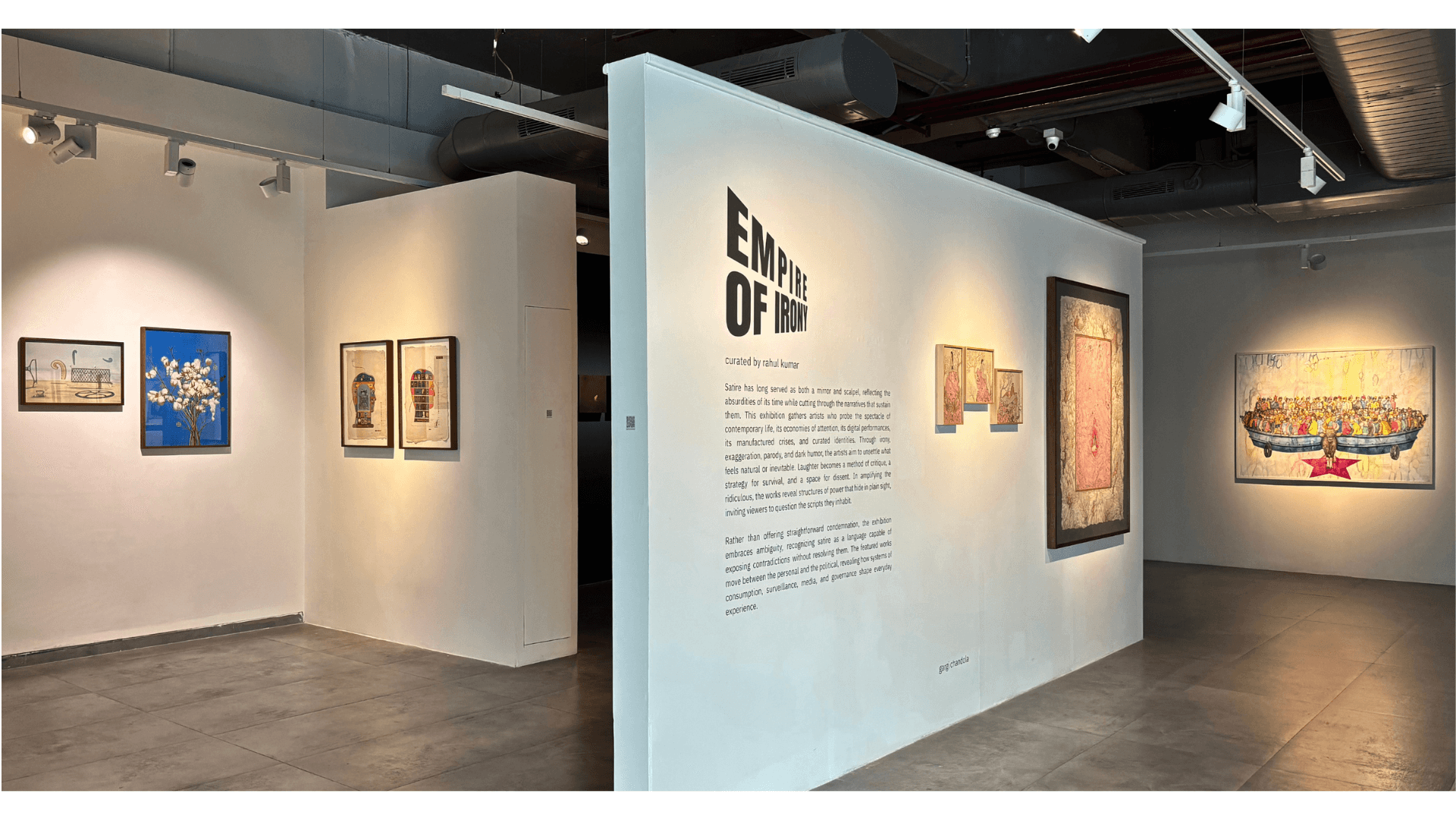
Satire has long served as both a mirror and scalpel, reflecting the absurdities of its time while cutting through the narratives that sustain them. This exhibition gathers artists who probe the spectacle of contemporary life, its economies of attention, its digital performances, its manufactured crises, and curated identities. Through irony, exaggeration, parody, and dark humor, the artists aim to unsettle what feels natural or inevitable. Laughter becomes a method of critique, a strategy for survival, and a space for dissent. In amplifying the ridiculous, the works reveal structures of power that hide in plain sight, inviting viewers to question the scripts they inhabit.
Rather than offering straightforward condemnation, the exhibition embraces ambiguity, recognizing satire as a language capable of exposing contradictions without resolving them. The featured works move between the personal and the political, revealing how systems of consumption, surveillance, media, and governance shape everyday experience. Humor functions not as an escape from these realities but as a means of confronting them, making visible the tensions that often remain concealed beneath familiarity and routine. By exaggerating the logic of forms, they expose the mechanisms through which desire, authority, and belief are produced and maintained. Their interventions challenge the boundaries between sincerity and performance, truth and fabrication, participation and spectatorship.
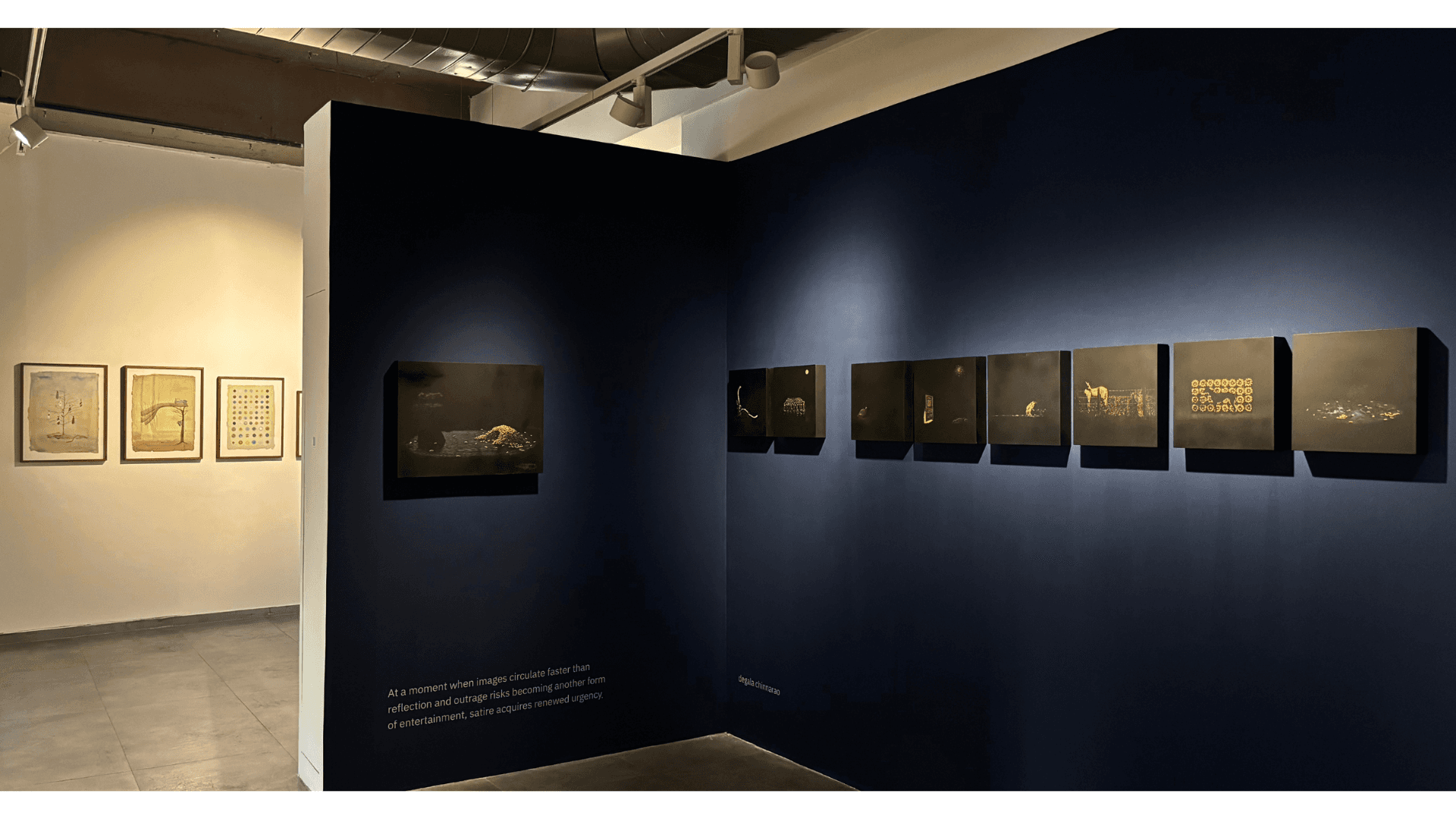
At a moment when images circulate faster than reflection and outrage risks becoming another form of entertainment, satire acquires renewed urgency. It encourages viewers to linger with discomfort, to recognize complicity alongside resistance, and to imagine alternatives beyond dominant narratives. The exhibition ultimately proposes satire not merely as a genre of humor but as a critical practice, one that resists complacency, invites collective reflection, and opens space for questioning the values, myths, and performances that define the contemporary condition.
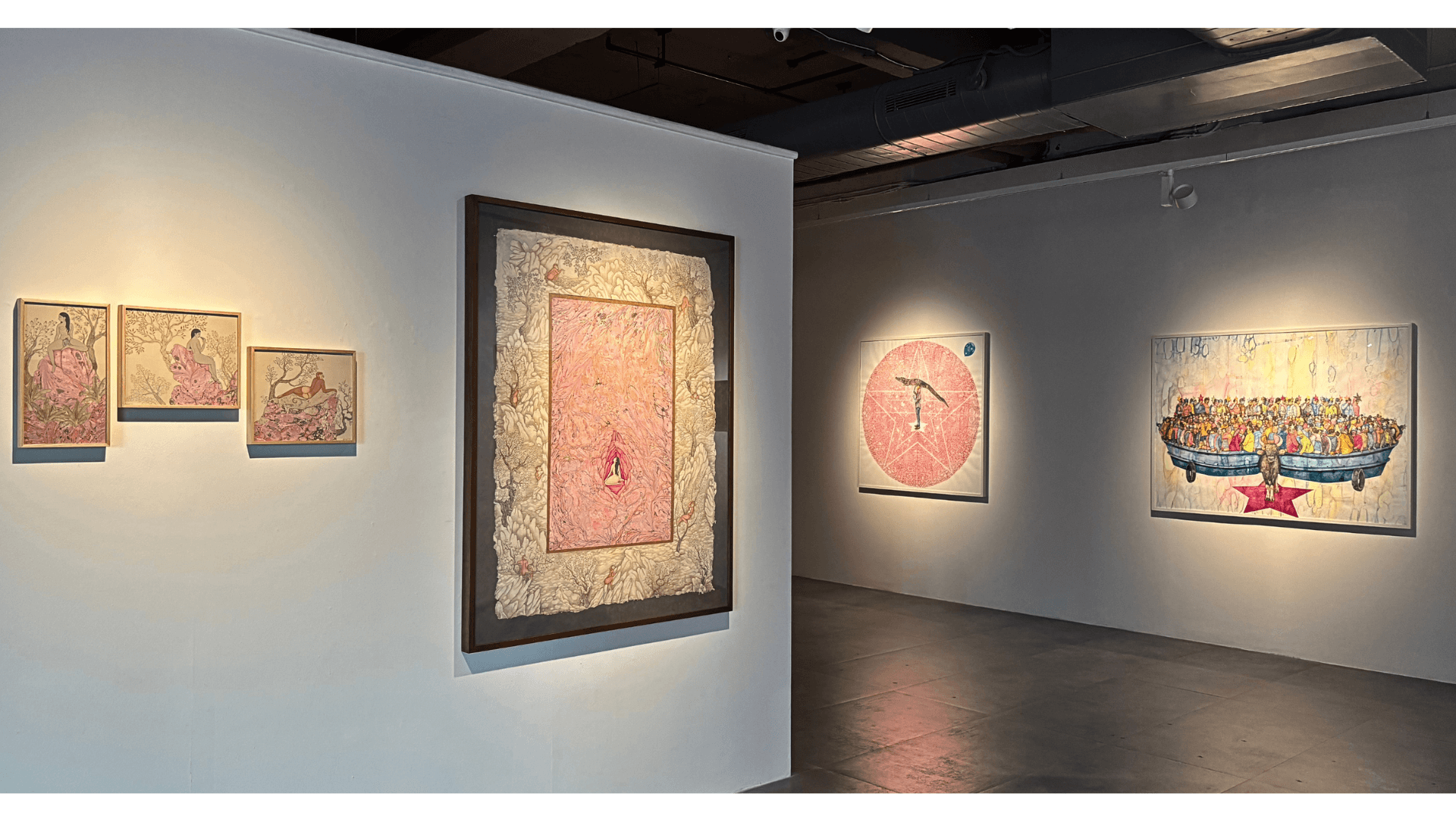
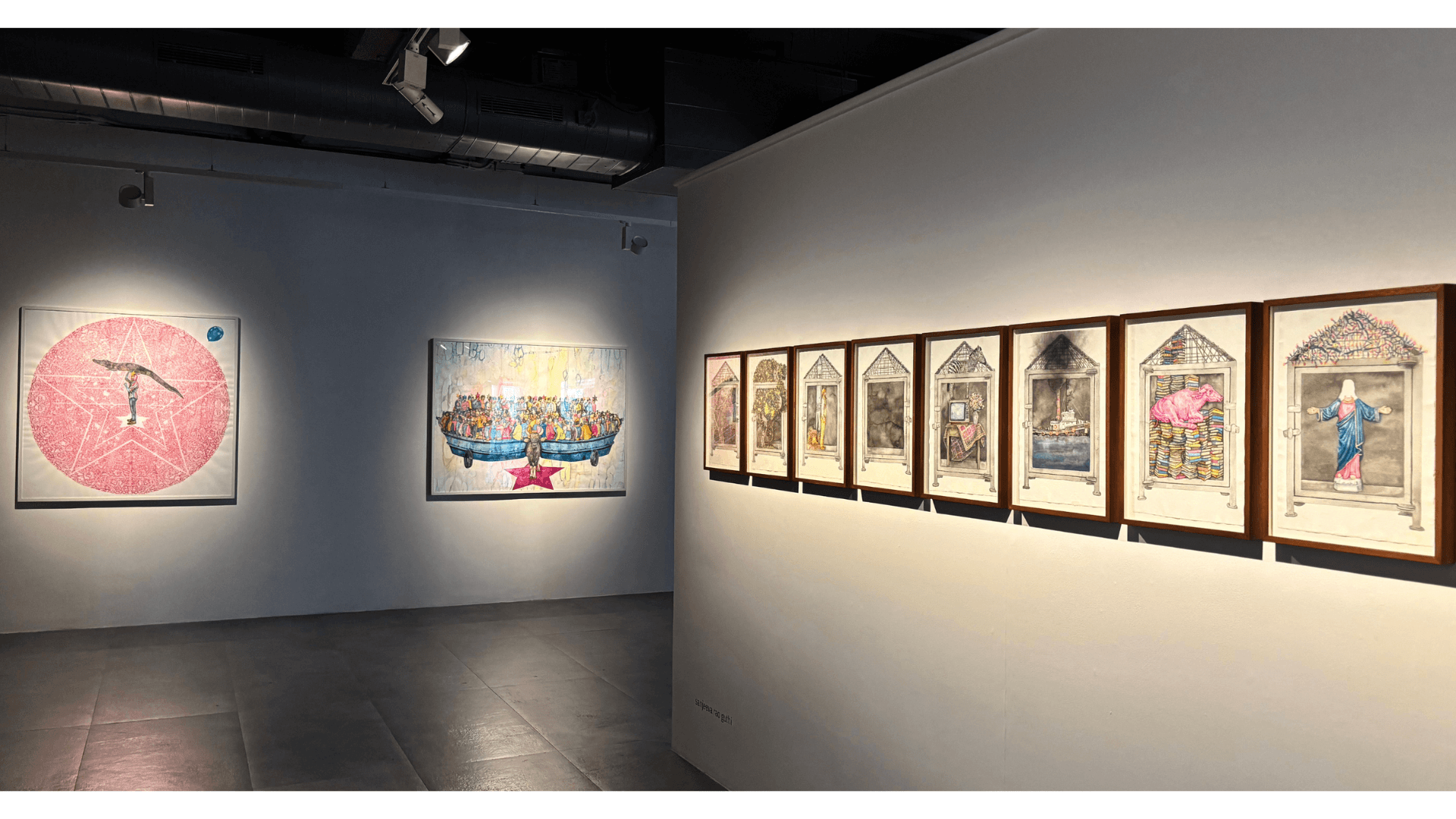
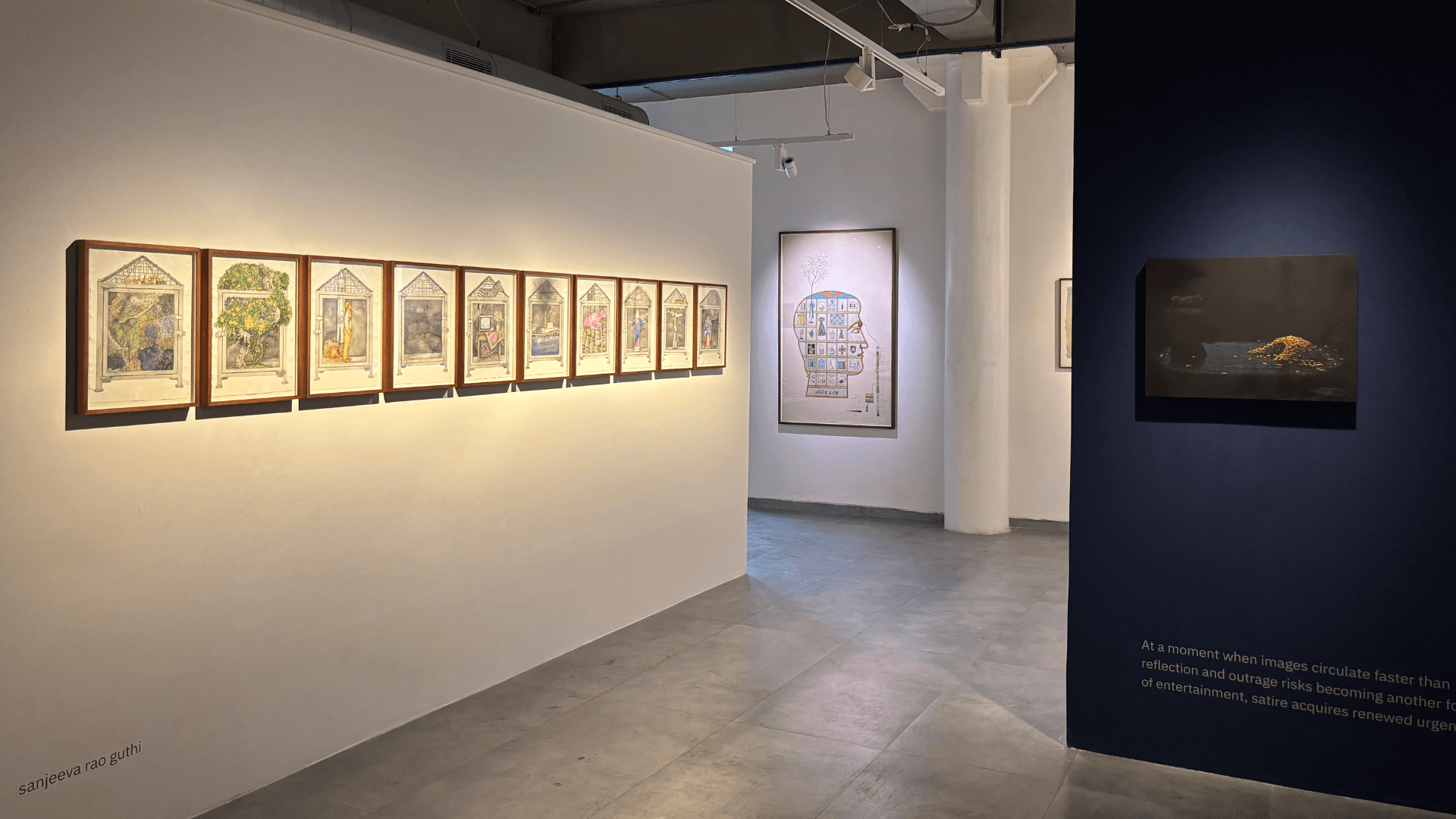
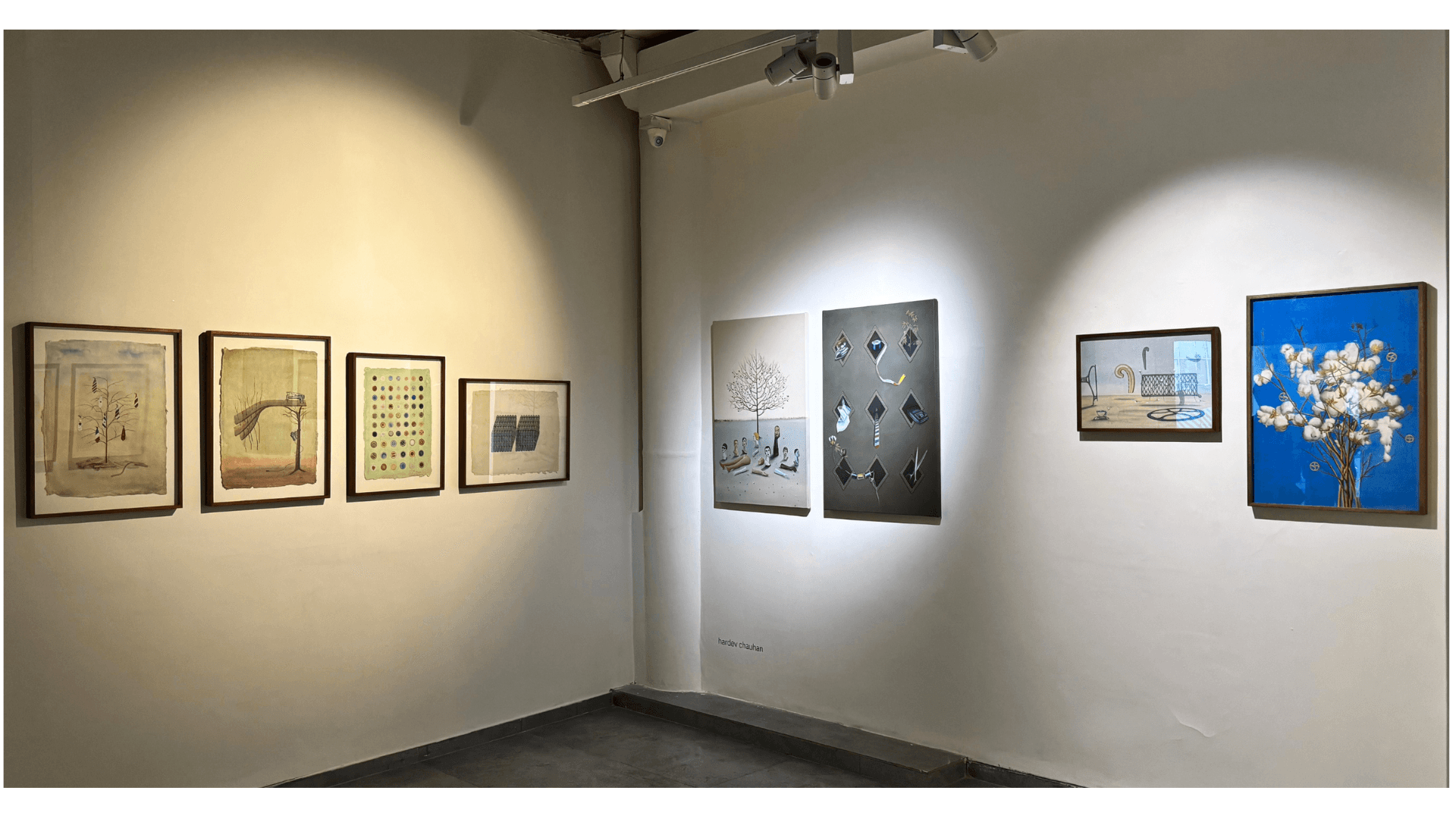
Debajit attempts to bridge the gap between memory, environment, and the surreal. His inspiration is the layered landscape of Tripura, where he grew up. Sparse and minimal in his approach, he offers a lens to view society through poetic gestures that emerge from everyday life. Ravi, in parallel, draws inspiration from India’s heritage, layered with political undertones. His works often emulate the strong, pristine lines of miniature painting, dabbling in experimentation through collage with gouache on rice paper. He also displays a reflective and pensive subjectivity, laden with play and contradictions. Hardev, in contrast, references agriculture, specifically cotton plantations and associated professions like garment manufacturing and tailoring. He aims to capture the delicate balance between nature and the impact of industrial development. Having formally studied applied arts and informally worked in a local tailoring unit, his work straddles these worlds. Illustrations, collages using print media, and photography often come together to form the imagery. Gargi is deeply influenced by her surroundings, a secluded, forested area where she shares space with a diverse array of flora and fauna. She documents their acts of carefree destruction of my seemingly ordered world, revealing a chaotic, deliberate reality that mirrors humankind. In her work, monkeys become reflections of the self, engaging in trickery, mind games, and violence in pursuit of the ultimate prize: bananas. As control shifts and evolutionary hierarchies blur, the boundaries between human and animal, man and woman, play and aggression dissolve. A distinctive element in her approach is an attempt at humor, sometimes subtle, sometimes blatant, used as both a coping mechanism and a tool for critique. Chinnarao, in contrast, observes the rural life of labour and intertwined rituals. Everyday community interactions are not isolated events. For him, they are living structures that construct identity and collective consciousness. He is interested in how these practices negotiate the space between devotion and necessity, violence and sustenance, tradition and transformation. Through careful observation and reinterpretation, his art examines how the human and animal body becomes central within these systems. Similarly, for Sanjeeva, social attitudes become visual metaphors. His response is to the individual ideas and navigation of identity, ego, and belonging within contemporary society. His art explores how these dynamics often reveal contradictions between appearance and inner reality. Animals become symbolic carriers of these ideas. Zebras and donkeys represent inflated egos and hollow ambition, for instance, and elephants emerge as recurring symbols of strength, memory, and integrity. Through the use of bold, vibrant colors, he attempts to capture a ‘look-at-me’ energy that exists within all of us.
Rahul Kumar
 Available
Yummy Choice
DEBAJIT R PAUL
Acrylic and Matte Varnish on Canvas · 18 x 30 in
 Available
Clean, No Green
DEBAJIT R PAUL
Acrylic and Matte Varnish on Canvas · 18 x 24 in
 Available
Wink Wink...Organic
DEBAJIT R PAUL
Acrylic and Matte Varnish on Canvas · 36 x 48 in
 Available
As Fast as Possible
DEBAJIT R PAUL
Acrylic and Matte Varnish on Canvas · 18 x 30 in
 Available
Don't Worry Love
DEBAJIT R PAUL
Acrylic and Matte Varnish on Canvas Board · Artwork: 12 x 16 in; Framed: 14 x 17.75 in
 Available
That Favourite Drum (Diptych)
DEBAJIT R PAUL
Acrylic and Matte Varnish on Canvas · Canvas Size: 24x24" each
 Available
Let's Make a Home There
DEBAJIT R PAUL
Acrylic and Matte Varnish on Canvas · 24 x 18 in
 Available
A Night Tour - (Triptych)
DEBAJIT R PAUL
Acrylic on Canvas · Artwork Size: 12x12" each
 Available
Make a Wish
DEBAJIT R PAUL
Acrylic and Matte Varnish on Canvas · 18 x 30 in
 Available
Buttons
HARDEV CHAUHAN
Watercolour on wasli paper · Artwork: 18 x 13 in; Framed: 23.25 x 18 in
 Available
Mannequin Head
HARDEV CHAUHAN
Watercolour on Wasli Paper · Artwork: 58.5 x 34.5 in; Framed: 61 x 37.5 in
 Available
A Field of Mannequins
HARDEV CHAUHAN
Oil on Canvas · 36 x 24 in
 Available
Untitled
HARDEV CHAUHAN
Watercolour and Acrylic on Fabriano Paper · Artwork: 27.5 x 19.5 in; Framed: 28 x 20.25 in
 Available
The Illusion of Status
HARDEV CHAUHAN
Watercolour on Wasli Paper · 58.5 x 34.5 in
 Available
Modern Colonials
HARDEV CHAUHAN
Watercolour, Gauache, Image transfer on wasli paper · Artwork: 21 x 16 in; Framed: 25.5 x 19.5 in
 Available
Untitled
SANJEEVA RAO GUTHI
Watercolour on Acid Free Paper · Artwork: 43.25 x 57 in; Framed: 44.75 x 58.5 in
 Available
Untitled
SANJEEVA RAO GUTHI
Watercolour on Acid Free Paper · Artwork: 46.5 x 46.5 in; Framed: 48 x 48 in
 Available
Untitled
SANJEEVA RAO GUTHI
Watercolour on Handmade Paper · Artwork: 16.5 x 12 in; Framed: 18.25 x 13.5 in
 Available
Untitled
SANJEEVA RAO GUTHI
Watercolour on Handmade Paper · Artwork: 16.5 x 12 in; Framed: 18.25 x 13.5 in
 Available
Untitled
SANJEEVA RAO GUTHI
Watercolour on Handmade Paper · Artwork: 16.5 x 12 in; Framed: 18.25 x 13.5 in
 Available
Untitled
SANJEEVA RAO GUTHI
Watercolour on Handmade Paper · Artwork: 16.5 x 12 in; Framed: 18.25 x 13.5 in
 Available
Reclining Nude King
GARGI CHANDOLA
Gouache on Marbled Wasli · Artwork: 9.75 x 11 in; Framed: 10.25 x 11.5 in
 Available
Thirst Trap
GARGI CHANDOLA
Gouache on Marbled Wasli · Artwork: 48 x 36 in; Framed: 55 x 43 in
 Available
On Firm Ground 2
GARGI CHANDOLA
Gouache on Marbled Wasli · Artwork: 13.25 x 7 in; Framed: 13.75 x 7.5 in
 Available
On Firm Ground 1
GARGI CHANDOLA
Gouache on Marbled Wasli · Artwork: 9.75 x 10.75 in; Framed: 10.25 x 11.25 in
 Available
A Toddler's World
DEGALA CHINNARAO
Ink and Oil Colour on Engraved Wood Block · 12 x 12 in
 Available
Silent Yield
DEGALA CHINNARAO
Ink and Oil Colour on Engraved Wood Block · 12 x 12 in
 Available
The Cost of Tomorrow
DEGALA CHINNARAO
Ink and Oil Colour on Engraved Wood Block · 18 x 24 in
 Available
The Field Never Sleeps
DEGALA CHINNARAO
Ink and Oil Colour on Engraved Wood Block · 12 x 12 in
 Available
The Last Bunch
DEGALA CHINNARAO
Ink and Oil Colour on Engraved Wood Block · 12 x 12 in
 Available
The Moon Knew
DEGALA CHINNARAO
Ink and Oil Colour on Engraved Wood Block · 18 x 24 in
 Available
The Price of Light
DEGALA CHINNARAO
Ink and Oil Colour on Engraved Wood Block · 12 x 12 in
 Available
The Shape of Memory
DEGALA CHINNARAO
Ink and Oil Colour on Engraved Wood Block · 12 x 12 in