
Fauvism: The Three Years Colour Stopped Behaving
August 19, 2026
In the summer of 1905, two painters travelled to a small fishing town on the French Mediterranean coast and asked a question nobody had quite asked before: what if colour didn't have to describe anything at all? What if a sky didn't need to be blue, a face didn't need to be flesh-toned, and a tree could be red simply because red felt right?
By the time they returned to Paris, the answer had a name and a scandal attached to it. Historians place Fauvism between 1904 and 1910, but its white-hot centre, the run of paintings people actually means when they say "Fauvist" happened in barely three years, 1905 to 1908, before the artists who started it had already moved on.
What Actually Happened
By 1904, Henri Matisse had worked his way through Impressionism's obsession with light and Post-Impressionism's competing answers to what should come next, Van Gogh's raw emotion, Gauguin's symbol, Cézanne's structure. But colour still described the world: skies were blue-ish, faces skin-toned. A stay in the south of France had exposed him to Mediterranean light's intensity, and contact with Paul Signac was already pulling his palette from naturalism. Still, the tether to reality hadn't snapped.
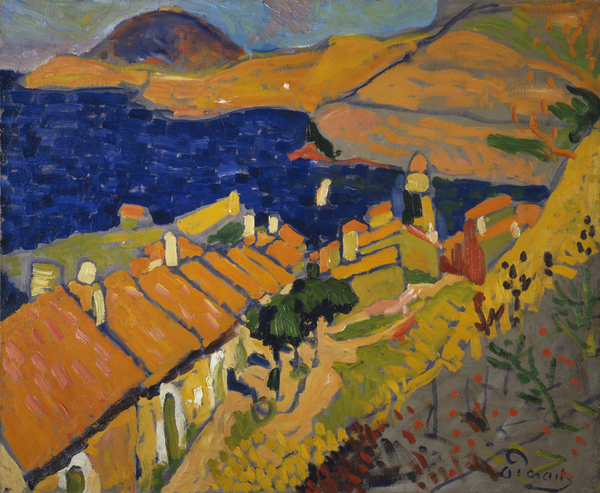
Then came Collioure. In July 1905, Matisse invited André Derain to the small fishing port near the Spanish border, and the two painted side by side there for nine intense weeks. Colour stopped imitating what the eye saw straight from the tube, unmixed, no longer tied to the object it covered. A face could be green, a tree trunk red. Derain later described their colours as "charges of dynamite." Nothing about the choices was random; the intensity was building sensation and structure, not chaos.
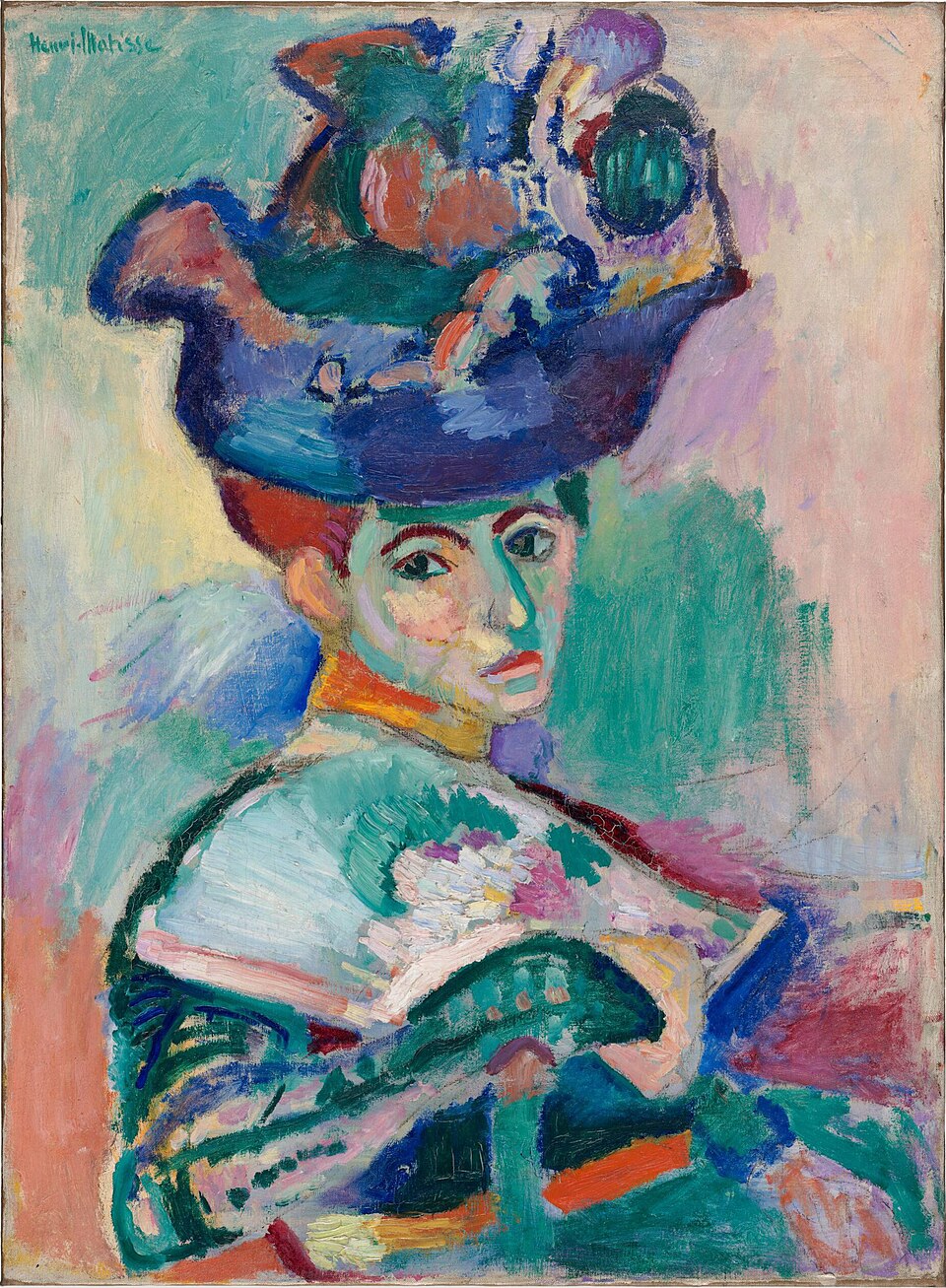
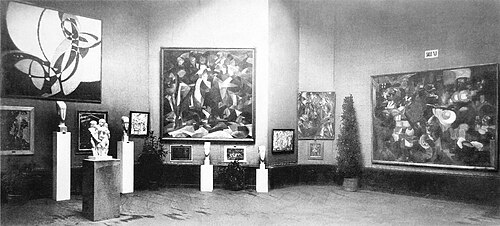
When the Collioure canvases were shown that autumn at the Salon d'Automne, Matisse's Woman with a Hat and a room full of similarly blazing canvases stopped visitors in their tracks. The critic Louis Vauxcelles is said to have looked around at the raw colour and, by one popular account, at a conventional bronze statue sitting incongruously among the paintings and remarked, "Donatello parmi les fauves": "Donatello among the wild beasts." He meant it as an insult, and wrote it into his review for Gil Blas. The painters kept the name anyway.
Colour had stopped describing reality; it had become the subject. The following spring, Matisse showed the much larger Le Bonheur de Vivre (The Joy of Life) at the Salon des Indépendants, and its unnaturally coloured, oddly proportioned nudes drew jeers again. It was also the painting that, more than any Collioure canvas, planted the idea that would grow into Picasso's Les Demoiselles d'Avignon a year later.
Why Then, Why Them
Fauvism didn't come from nowhere Post-Impressionism had loosened the hinges. Van Gogh proved colour could carry raw feeling; Gauguin flattened it into symbol. By the time Matisse and Derain sat down at Collioure, the idea of colour breaking free from description was already in the air; they simply pushed it further.
A quieter influence: Gustave Moreau, the Symbolist painter who taught Matisse, Rouault and Marquet, and pushed his students toward trusting instinct over academic convention. Matisse later said Moreau "didn't set his pupils on the right road, he roused our imagination." Paris also had the right stage the Salon d'Automne, founded in 1903 as a jury-free alternative to the official Salon, gave young, unproven painters somewhere to show work the establishment would never have hung.
Matisse and Derain are the ones history remembers, but the Salon room held more than two painters. Vlaminck was there from the start, and the circle soon widened to include Kees van Dongen, Georges Rouault, Albert Marquet and others with Georges Braque and Raoul Dufy joining the following year. For most of them, Fauvism was a single, formative chapter rather than a lifelong style.
One more thread is worth naming: from around 1905, Vlaminck, Derain and Matisse began collecting African and Oceanic sculpture, drawn to its flattened forms, Matisse travelled to North Africa himself in 1906. It shaped how the Fauves treated the human figure. It's also, in hindsight, a clear example of European artists absorbing colonial-era objects without crediting the cultures that made them. Both things are true at once.
How to Spot a Fauvist Painting?
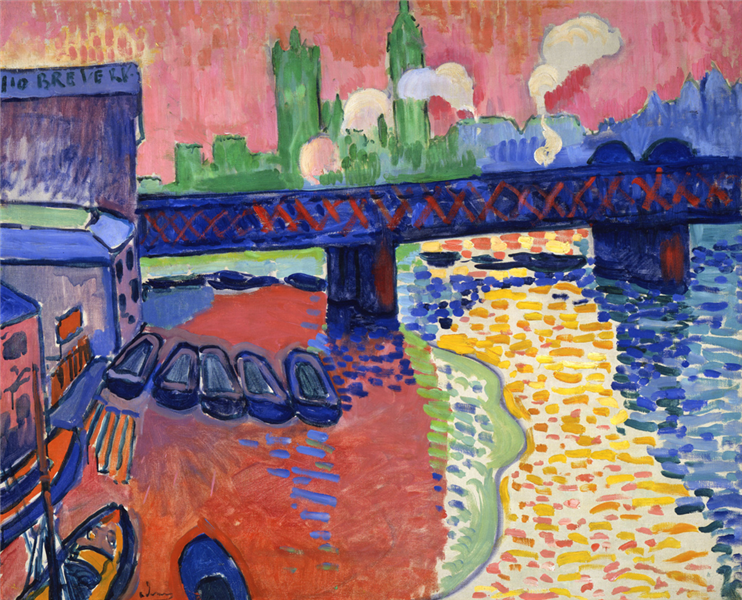
-Pure, unmixed colour — straight from the tube, no blending. Reds sit next to greens, purples next to yellows, chosen for jolt and energy rather than accuracy.
-Colour detached from the object — a face can be green, a tree trunk red. Colour carries emotion, not description.
-Flattened space, simplified form — shading and linear perspective are largely abandoned; colour itself creates depth.
-Visible brushwork — paint stays thick and direct, the evidence of the artist's hand part of the image.
-Ordinary subjects, radical treatment — portraits, Mediterranean landscapes, café scenes. Nothing about what they painted was shocking. Everything about how was.
The World Around It
Fauvism happened inside a Europe rearranging itself in every direction at once. In France, 1905 was the year church and state formally separated, ending a century-old alliance between government and the Catholic Church. A year later, Alfred Dreyfus, wrongly convicted twelve years earlier was fully exonerated. Two years after the Fauves' scandal, Picasso drew on the same African sculpture they'd started collecting to paint Les Demoiselles d'Avignon. And in 1908, Vauxcelles the same critic who named the Fauves looked at Braque's rejected landscapes and coined another word: "cubes." Fauvism's moment at the front of the avant-garde was already closing.
Music was working through something similar. Debussy's La Mer (1905) treated the sea as something to be felt rather than depicted; Strauss's Salome, that same year, strained tonality to its limits. By 1907–08, Schoenberg's Second String Quartet abandoned a fixed key altogether the first step toward atonal music while Scriabin, fascinated by synesthesia, composed The Poem of Ecstasy as if sound itself were colour. Painters and composers were, without coordinating, pushing their raw material past the point of describing reality — and finding it could still hold together as art.
What Was Happening in India at the Same Time
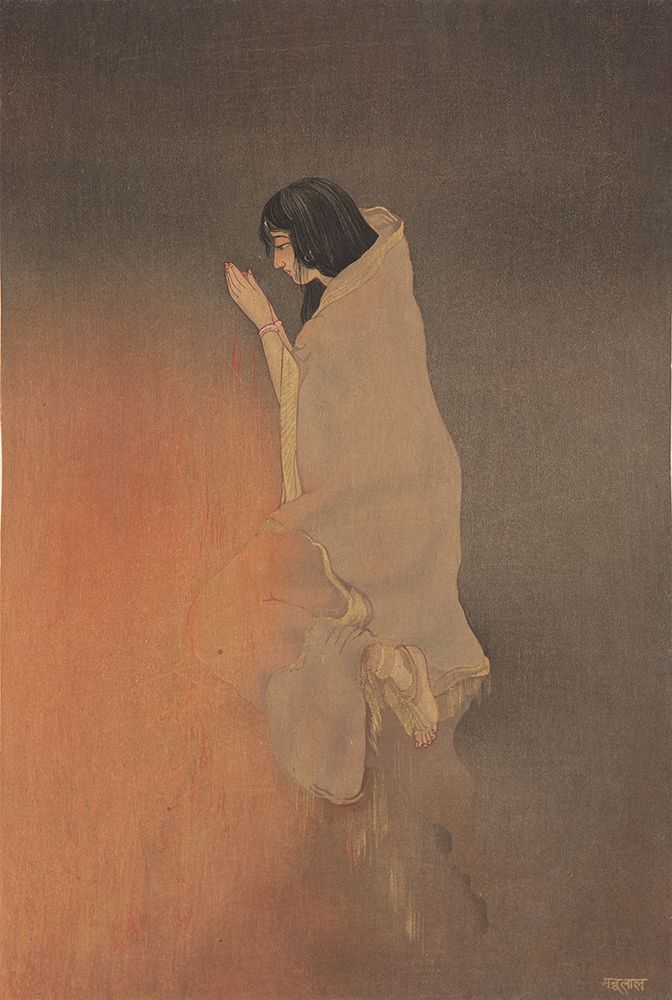
While Matisse and Derain were unmixing paint in Collioure, Bengal was going through its own break from realism, for nearly the opposite reason.
The Swadeshi movement, born of the 1905 boycott of British goods following the Partition of Bengal, fed a rising appetite for a distinctly Indian visual language. In 1907, Abanindranath and Gaganendranath Tagore founded the Indian Society of Oriental Art in Calcutta, formalising the Bengal School's break from European academic realism. At the Society's inaugural exhibition in 1908, Nandalal Bose showed Sati and Siva and Sati — Sati, rendered in the Japanese wash technique, won the first prize of Rs. 500. The following year he joined the team copying the Ajanta cave murals.
Where the Fauves broke from realism to chase raw, personal sensation, the Bengal School was breaking from it at the same moment to recover something older a spiritual and national inheritance drawn through Mughal, Rajput and Ajanta-influenced technique. Two movements, on opposite sides of the world, arriving at the same rejection of academic realism for entirely different reasons.
A quieter Indian echo: Kalighat pat, the cheap devotional scroll paintings sold near Calcutta's Kalighat temple, had used bold outlines and flat, unmixed colour since the early nineteenth century, entirely outside any academic tradition, and were still being made the very years Fauvism was being named in Paris. Jamini Roy (1887–1972) wouldn't arrive at this language for another two decades trained in Western portraiture, he broke from it only in the mid-1920s, trading imported oils for the pat's bold lines and traditional pigments, announcing his mature style at a 1929 Calcutta show. Roy was never a Fauvist, and Kalighat painting was never an Indian Fauvism, but the comparison is a reminder that strong colour wasn't a European invention.
Three Painters, Three Directions
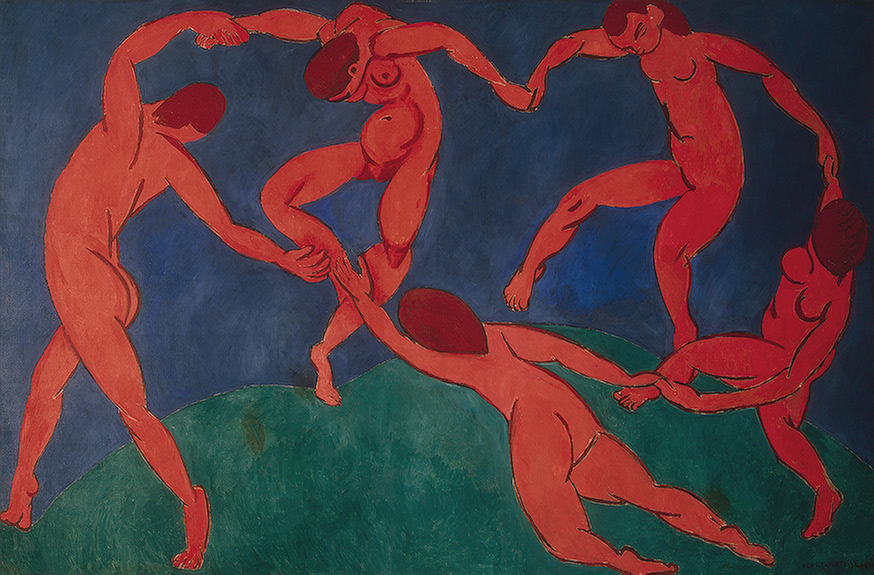
Henri Matisse (1869–1954) — Woman with a Hat (1905), The Joy of Life (1905–06). Vauxcelles called him Fauve-in-chief, and it fit. Matisse stayed the group's clearest voice, steering colour toward decoration and structure rather than pure shock. In his 1908 essay Notes of a Painter, he wrote of wanting "an art of balance, of purity and serenity" a calm ambition next to the violence critics saw in his colour. He moved past Fauvism within a couple of years but never dropped its lesson; freed colour carried him for five more decades, through flattened interiors, the mural-scaled Dance, and the paper cut-outs he made from a wheelchair in his final years in Nice.
André Derain (1880–1954) — Mountains at Collioure (1905), Charing Cross Bridge, London (1905–06). Derain worked easel-to-easel with Matisse that Collioure summer, calling it their "ordeal by fire." In 1906, the dealer Ambroise Vollard sent him to paint London, and Derain rendered the grey Thames in the same unmixed reds, greens and yellows he'd used on the Mediterranean proof the real subject was colour's freedom, not southern sunshine. By 1908 he had turned toward Cézanne's structure and a far more restrained, classical style.
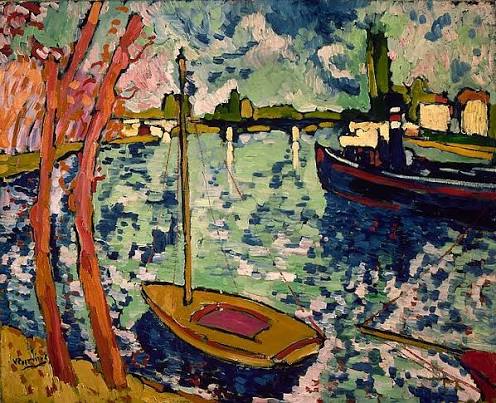
Maurice de Vlaminck (1876–1958) — The River Seine at Chatou (1906), Tugboat on the Seine, Chatou (1906). The least trained and most instinctive of the three almost entirely self-taught, and proud he'd never set foot in the Louvre. He met Derain by chance after a train accident in 1900, and the two shared a studio in Chatou, painting the same bridges and poplar trees in colours neither cared to soften, with a rawness owing an obvious debt to Van Gogh. "I heightened all the tones," he said later. "I was a tender barbarian filled with violence." His Fauvist period, like Derain's, was short by 1908 he too had turned toward Cézanne, his palette settling darker over the decades that followed.
Where It Landed
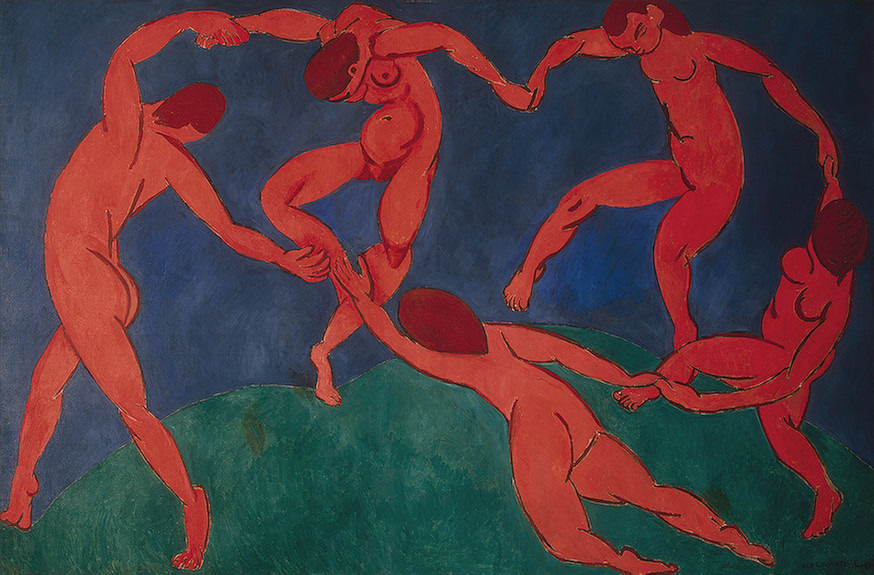
In March 1909, the Russian textile magnate Sergei Shchukin commissioned Matisse to paint two large decorative panels Dance and Music for the staircase of his Moscow mansion. Matisse first worked out the composition in a full-scale study, Dance (I), now at the Museum of Modern Art in New York, before completing a bolder, far more saturated final version the following year. By then Fauvism as a group effort had scattered Derain toward Cézanne, Vlaminck toward sombre landscape. Matisse alone kept pushing the idea, paring his palette to three colours only: terracotta-red bodies, a blue sky, a green hill, shadow and perspective almost entirely gone.
Shchukin, on first seeing the finished panels, cabled Matisse to say he couldn't accept them, the nudity unsettled him. He changed his mind within days, and later called them the best paintings in his collection. Paris wasn't as quick to come around: when Dance was shown at the 1910 Salon d'Automne, one critic dismissed it as "the work of a child." The panels hung in Shchukin's mansion until the Russian Revolution, when his collection was nationalised in 1917 and he fled, never to return; both now belong to the Hermitage. By then their influence had already spread well beyond Paris a scandal in one Salon room in 1905 had, within five years, become one of the founding images of modern painting.
It's worth remembering, too, that Fauvism was never a movement in the organised sense. The Impressionists ran a formal, dues-paying society with elected officers and years of self-organised exhibitions. The Fauves had none of that no manifesto, no membership. They were held together by friendship and one sympathetic dealer, Berthe Weill, who had been giving several of them group shows as early as 1904, before the group had a name. A critic supplied that name in a single review; by 1908 the artists it described were already moving apart. Fauvism named a moment, not an institution.
Why It Still Matters
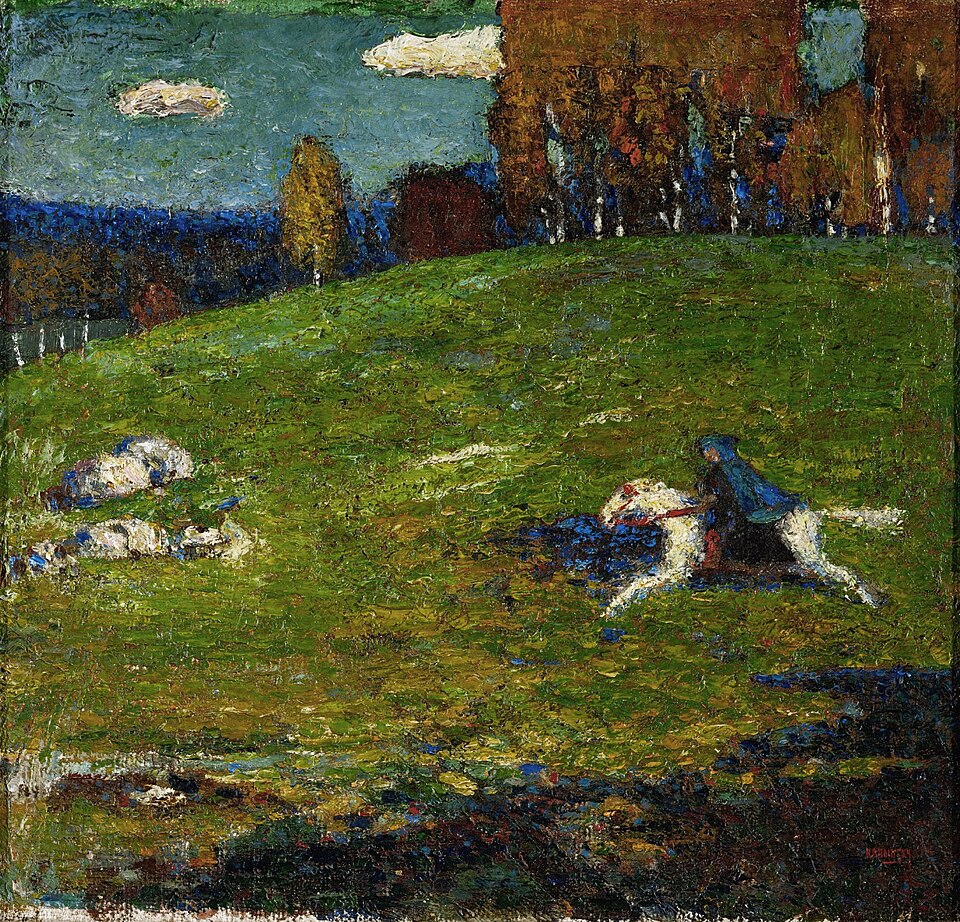
Fauvism is usually remembered as a short, loud scandal one room at one Salon, three years, a name that started as an insult. But its real contribution was smaller and stranger: colour didn't need to describe anything to hold a painting together. Once that had been proven on canvas, it couldn't be unproven.
Der Blaue Reiter, formed a few years later in Munich, pushed that freed colour toward the spiritual and the nearly abstract historians trace Kandinsky and Marc's heightened palettes directly back to Collioure. The African sculpture the Fauves had begun collecting fed straight into Picasso's Demoiselles d'Avignon and the beginnings of Cubism. Decades on, Mark Rothko named Matisse's The Red Studio his favourite modern painting, saying it left him "totally saturated" in colour.
Before Fauvism, colour was mostly expected to tell us what something looked like. After it, colour could tell us how something felt and that distinction became one of the foundations everything modern would build on. A scandal in one Paris salon in 1905 is still, in some form, how a good part of modern painting chooses to work.